The Permanent Construction Zone

There is something psychologically exhausting about living in a place that never seems finished.
Not “undergoing renewal.”
Not “investing in the future.”
Not “modernizing infrastructure.”
Just… perpetually unfinished.
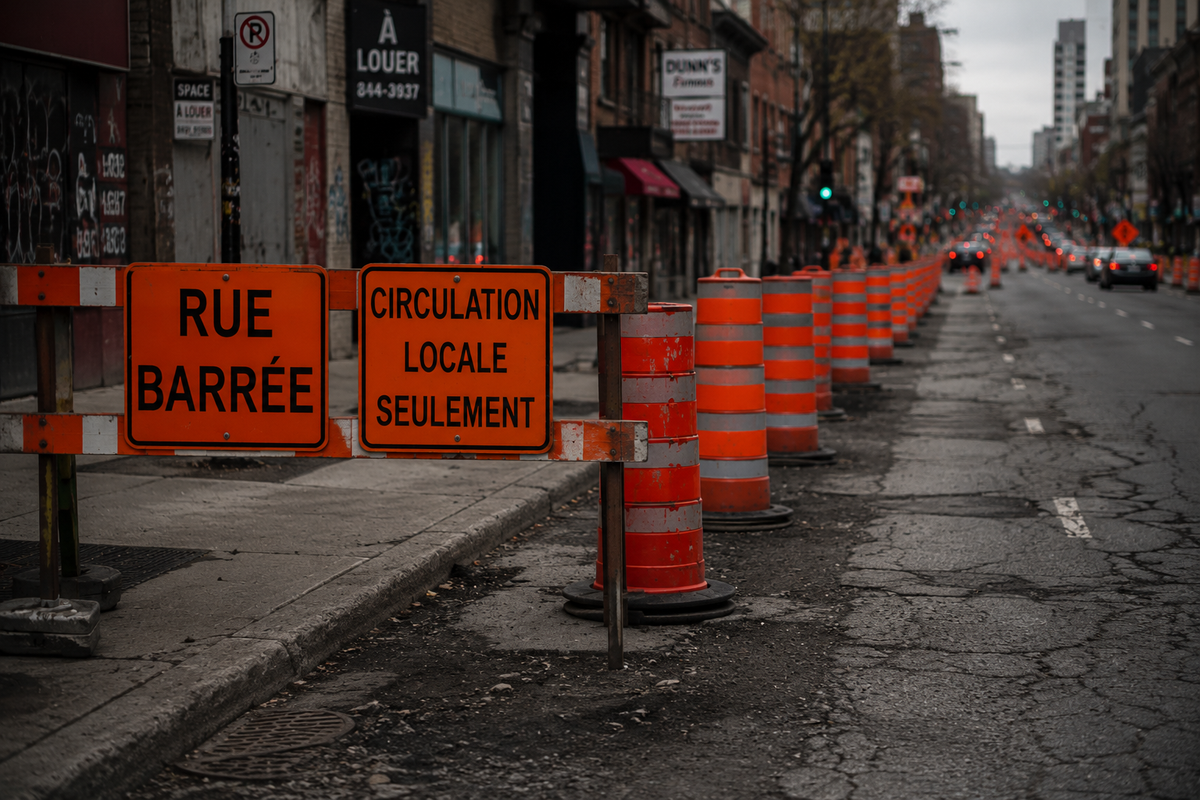
Anyone who has lived in or around Montreal long enough knows exactly what I mean. The orange cones are not an event anymore. They are part of the geography. They are as permanent as the guardrails and overpasses themselves.
Entire highways exist in a constant state of partial closure. Downtown streets become incomprehensible mazes of one-ways, detours, barriers, temporary lane markings, temporary sidewalks, temporary lights, temporary signs, temporary everything. You leave your house one morning and the route you’ve driven for years suddenly no longer exists.
And what’s most disturbing is not the inconvenience itself.
It’s how normal it has become.
Every morning, I drive Highway 13 to get to work. At five in the morning — five — traffic is already backed up.
And the strange part is that I almost feel silly even pointing this out.
That’s how normalized it has become.
I can already hear the internal response:
“Well yeah… obviously there’s traffic.”
Except there should not be standstill traffic before sunrise on a major artery unless something has gone seriously wrong in the design or operation of the system itself.
But after enough years living here, absurdity slowly stops feeling absurd.
It just becomes routine.
And now they’re reducing it to two lanes for the entire summer.
Again.
Everyone already knows what’s coming:
- endless gridlock,
- endless rerouting,
- endless frustration,
- endless explanations,
- endless press conferences,
- endless “phases.”
But almost nobody seriously believes the suffering will produce a finished result worthy of the disruption.
That’s the part that’s hard to articulate unless you’ve lived here for years.
Construction itself is not the problem.
People tolerate construction everywhere on earth. Germans tolerate it. Japanese people tolerate it. Americans tolerate it. The difference is that in functioning societies, construction still feels connected to completion.
You endure the inconvenience because you believe you are moving toward something.
Here, many people no longer believe the finished version is coming.
That changes everything psychologically.
The Civilization of Permanent Repair
When I drove across Germany years ago, I remember seeing construction signs on the Autobahn and bracing for the familiar nightmare.
But then… nothing happened.
There was a slight bump in the pavement. Maybe a narrowed lane for a moment. Then suddenly it was over. The road was smooth again. Clean. Finished. Functional.
The experience was so uneventful that it became memorable precisely because it contrasted so violently with Quebec.
Meanwhile here, roads often resemble infrastructure after a natural disaster. Cracks everywhere. Violent frost heaves. Patches over patches over patches. Suspension-destroying potholes appearing faster than crews can repair them.
Vehicle damage has become so common that people discuss bent wheels and blown suspensions here the way people elsewhere discuss bad weather.
And somehow this has become culturally normalized.
That normalization is the real story.
Because the deeper problem in Quebec is not simply inefficiency. It is that we have collectively adapted to chronic underperformance.
The public no longer expects competence from public systems.
That sentence sounds dramatic until you really think about it.
Imagine growing up in a city where:
- roads are perpetually broken,
- construction is perpetual,
- detours are constant,
- timelines mean nothing,
- closures last years,
- major arteries operate below capacity indefinitely,
- and visible decay becomes part of the aesthetic identity of the place itself.
Eventually your brain recalibrates.
You stop asking:
“Why is this happening?”
And start saying:
“That’s just Quebec.”
That shrug is one of the most dangerous cultural responses a society can develop.
Because once dysfunction becomes normalized, urgency disappears.
The Orange Cone as a National Symbol
The orange cone has become something far beyond a traffic device in Quebec.
It has become symbolic of suspended progress.
As children, construction means something exciting:
They’re building something.
As adults in Montreal, construction often feels like:
They are occupying space indefinitely.
That distinction matters.
Because infrastructure is not merely practical. It is psychological.
A clean, flowing, functional city communicates:
Human effort here accumulates into something meaningful.
But perpetual closures, temporary patches, and endless half-finished projects communicate something else:
Nothing is ever truly completed here.
And after enough years, citizens begin to emotionally detach from the idea of collective civic achievement altogether.
The city stops feeling like:
our shared project,
and starts feeling like:
an obstacle course we individually survive.
That is an incredibly corrosive mindset for a society to drift into.
The Aesthetics of Progress
And this is where things become almost surreal.
Because while the broader system deteriorates, Quebec — and Montreal especially — has become extraordinarily good at producing highly photogenic fragments of progress.
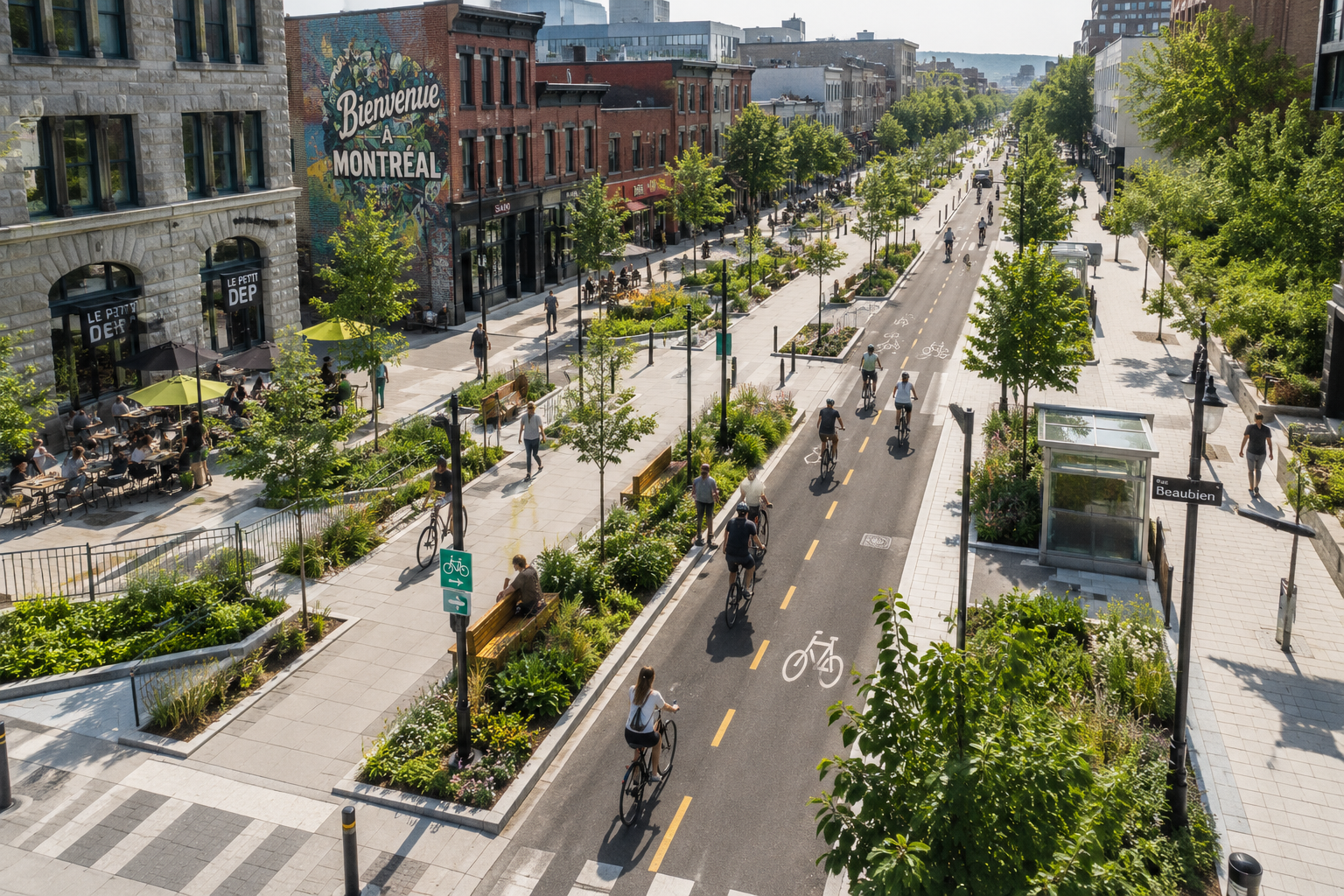
A downtown street gets completely redesigned for two beautiful blocks:
- gorgeous bike paths,
- elegant greenery,
- modern lighting,
- carefully selected paving stones,
- sleek benches,
- happy pedestrians,
- perfect camera angles.
Then come the photos.
The smiling mayor.
The drone footage.
The polished article headlines.
The glowing language about “reimagining urban mobility.”
The carefully curated symbolism of progress.
And for a brief moment, the city looks like Copenhagen.
But it often feels strangely theatrical.
Like a movie set.
Not fake, exactly. The work is real. The improvements are real. But the presentation feels disconnected from the broader lived reality surrounding it.
Just outside the camera frame:
- traffic is paralyzed,
- businesses are suffocating under endless construction,
- roads are crumbling,
- detours are incomprehensible,
- commuters are burning hours of their lives every week,
- and entire districts remain trapped in permanent infrastructural limbo.
The immaculate two-block corridor becomes a miniature model of a functioning city — beautiful from the right angle, under the right lighting, for the duration of the photoshoot.
And then everyone goes home feeling like progress has occurred.
Meanwhile the actual city — the real city — continues grinding itself to pieces underneath.
That disconnect is what creates cynicism.
Not because people hate progress.
But because people increasingly distrust staged progress.
The Performance of Competence
Modern governance increasingly rewards the appearance of progress more than the completion of it.
That is not uniquely Quebecois. It is a broader Western problem. But Quebec often feels like an extreme version of it.
We have become experts at:
- announcements,
- studies,
- consultations,
- phased rollouts,
- branding,
- communications strategies,
- symbolic victories,
- curated imagery,
- and controlled narratives.
But the lived operational reality often remains chaotic.
The average commuter does not experience governance through press releases.
They experience it through:
- potholes,
- traffic,
- delays,
- broken infrastructure,
- confusing systems,
- lost time,
- and accumulated friction.
And that friction compounds over years into something much heavier than annoyance.
It becomes demoralization.
Because deep down, infrastructure is one of the ways a civilization signals seriousness to its citizens.
When systems work well, people subconsciously feel:
someone competent is steering the ship.
When systems visibly decay year after year with no meaningful improvement, citizens begin to lose faith not just in roads, but in institutions themselves.
And once that erosion of trust begins, it spreads everywhere.
The Most Dangerous Part
The most dangerous part is not collapse.
Quebec is not collapsing.
In some ways, that makes this more troubling.
Because what we are witnessing is a society that has learned how to function indefinitely at a low level of competence.
Enough functionality to survive.
Enough wealth to maintain appearances.
Enough bureaucracy to manage perception.
Enough adaptation from citizens to absorb the consequences.
The commuters absorb the cost.
The taxpayers absorb the cost.
Ordinary people absorb the cost:
- damaged vehicles,
- wasted fuel,
- longer commutes,
- lost productivity,
- chronic stress,
- lowered expectations.
And the system continues uninterrupted.
That is why reform feels so elusive.
Because according to the system’s own incentives, the system is not truly failing.
The roads still technically operate.
The projects continue.
The announcements continue.
The ribbon cuttings continue.
The elections continue.
Meanwhile, millions of people slowly recalibrate their definition of “normal” downward.
And once a population stops expecting competence, dysfunction becomes self-sustaining.
We Should Be Angry
Not irrationally angry.
Not tribalistically angry.
Not performatively angry.
But genuinely, morally angry.
Because none of this should be considered acceptable in one of the wealthiest societies on earth.
We should not accept highways that resemble war zones.
We should not accept years-long closures with microscopic visible progress.
We should not accept cities that feel permanently under repair but never repaired.
We should not accept institutional cultures that treat public inconvenience as background noise.
Most importantly:
we should not accept the idea that expecting competence is naïve.
Because the moment a society loses its expectation of competence, it begins drifting toward managed decline without even realizing it.
And that may be the most unsettling realization of all.
The cones were never temporary.
They became part of who we are.